A driveway or a set of front steps is one of the few home projects you pour once and live with for 25 years. There's no do-over without jackhammers. So before you sign anything, it's worth knowing what separates a contractor who does this right from one who just owns a mixer truck.
Lawrence sits in the Merrimack Valley, and the ground here isn't uniform. Some lots near the river have sandy, well-draining soil. A lot of the older neighborhoods, Tower Hill, South Lawrence, the streets around the old mill district, sit on glacial till with ledge not far below the surface. That changes how a job gets excavated and priced. A contractor who gives you a flat number over the phone without asking about your lot hasn't accounted for the fact that half the driveways in this city hit rock at 18 inches and the other half don't hit it at all.
Licensing and insurance, actually checked
Massachusetts requires a Home Improvement Contractor registration for most residential work, and a Construction Supervisor License for anything involving structural work like a foundation or a retaining wall over a certain height. Ask for the registration number and look it up yourself rather than taking a business card's word for it. Ask for a certificate of insurance showing general liability, and ask that it name you or your address, not just a generic policy number. If a crew falls off your front steps, you don't want that landing on your homeowner's policy.
This matters more in a city like Lawrence than it might in a brand-new subdivision, because a lot of the housing stock here is close to a hundred years old. Triple-deckers built in the mill era, narrow lots, property lines a few feet apart. A driveway extension or a new walkway on one of these lots can brush up against a setback line fast. A contractor who's worked here knows to check the plot plan before digging, not after the inspector flags it.
What happens under the slab matters more than the slab
Concrete is only as good as what's underneath it. The standard here is 4 to 6 inches of compacted crushed stone under a driveway or patio, more under a slab that'll carry a car or a dumpster. Skip that step, or compact it poorly, and you get settling within a year or two, cracks that follow the low spots. Ask how many inches of base they're putting down and what they're compacting it with. A plate compactor run over loose gravel for five minutes isn't the same as a proper base.
Frost depth is the other piece people don't ask about. Massachusetts code generally calls for footings to sit below the frost line, which in this part of the state runs around 42 to 48 inches. A stoop or a set of steps tied into the house needs a footing that goes down that far, or it'll heave in winter and crack away from the foundation. A patio floating on its own doesn't need to go that deep, but a frost-footed structure does, and a contractor who quotes a shallow footing to save a day of digging is setting you up for a problem in three winters, not none.
Freeze-thaw is the real enemy here, not heat
New England doesn't get the kind of heat that cracks concrete the way it does in the south. What it gets is roughly four months, November through March, of repeated freezing and thawing, plus road salt tracked onto driveways all winter. That combination causes scaling, the flaking and pitting you see on older driveways where the surface looks like it's peeling. The fix is air-entrained concrete, mixed with tiny air bubbles that give water room to expand when it freezes instead of blowing the surface apart. Ask whether the mix is air-entrained and what percentage, 5 to 7 percent is typical for exterior flatwork around here. A contractor who doesn't know this detail off the top of their head probably isn't specifying it.
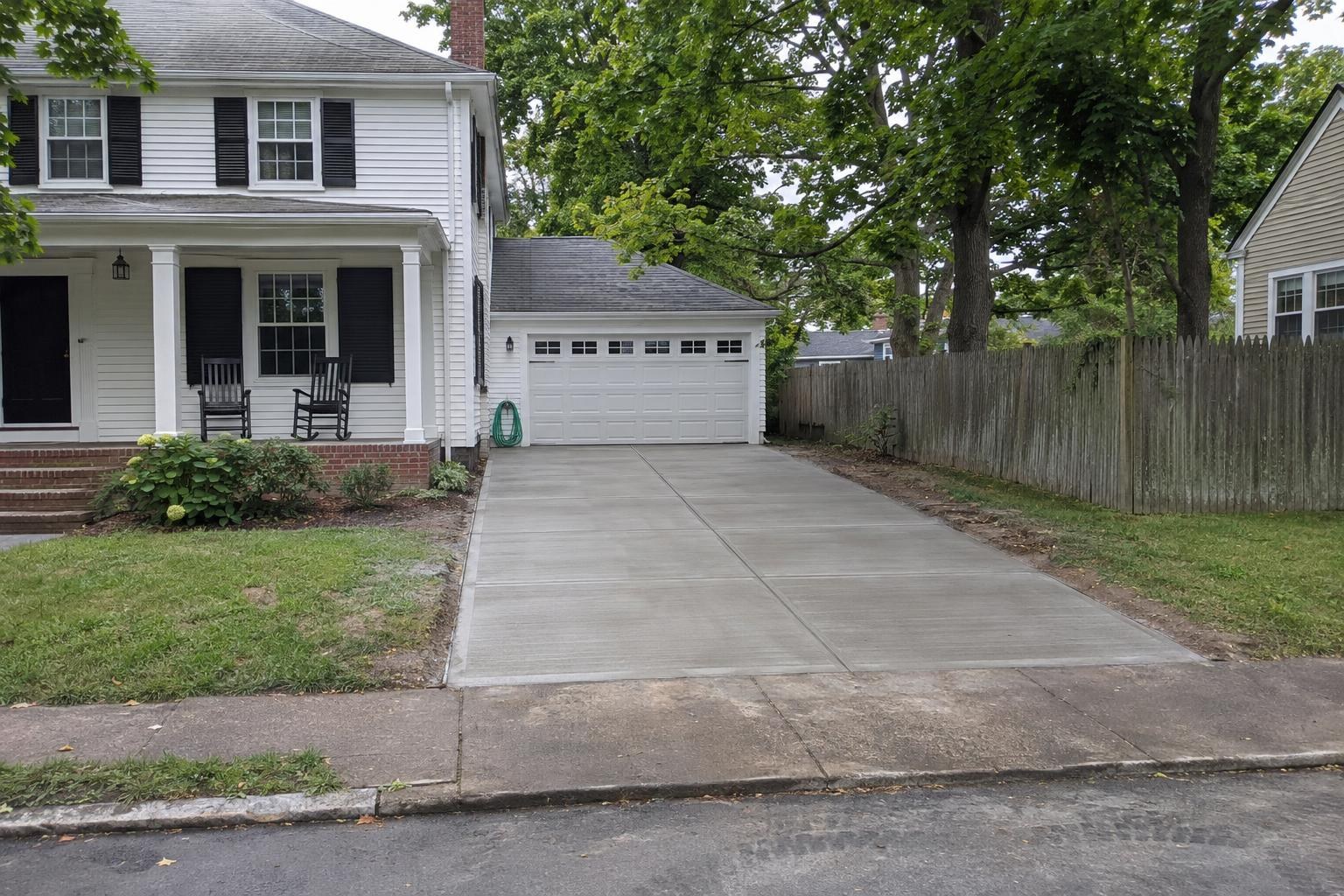
Control joints matter for the same reason. Concrete is going to crack somewhere, that's just what the material does as it shrinks while curing. The joints are there to tell it where. On a driveway slab, that generally means a joint every 8 to 10 feet, cut within hours of the final finish, not days later once the slab has already picked its own crack line.
Timelines you should expect
A new driveway or patio is generally walkable in 24 to 48 hours and ready for a car in about 7 days, though it keeps gaining strength for a full 28 days before it's at its rated strength. If a contractor tells you it's fine to park a truck on it the next day, that's a mix that'll show stress marks before summer. On the flip side, if someone tells you it needs three weeks before you can even walk on it, that's not accurate either, and it's worth asking why they said it.
Red flags worth walking away from
- A bid that's dramatically lower than two or three others for the same scope, with no explanation of thinner base or no rebar.
- No written contract, or one that doesn't spell out thickness, base depth, and reinforcement, wire mesh versus rebar.
- A request for full payment up front before any work starts.
- No fixed address, just a cell number and a truck.
- Reluctance to pull a permit. The city requires one for slab work tied to a structure, and for retaining walls over a certain height, and the inspection at footing stage is there to catch exactly the problems described above before they're buried under concrete.
HOAs aren't common in most of Lawrence's older neighborhoods, but they do show up in some of the newer developments toward Andover and North Andover. If you're in one, check whether a driveway material change or a stamped pattern needs sign-off before the truck shows up.
None of this is complicated, it's just detail that takes longer to explain than it does to skip. A contractor who walks your lot, asks about your soil, and talks about base depth and joint spacing before you've even asked is one who's done this enough times to know where it goes wrong. That's the kind of groundwork Hardrock Concrete Construction puts in before a single yard of concrete gets poured.